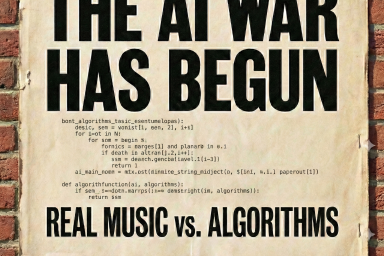
An overview of the AI tools changing how music is made, the policies streaming services use, and the challenge of content saturation.
AI has quickly transformed from a novelty to a utility in music creation, enabling anyone to produce high-quality tracks instantly. However, this accessibility has placed massive strain on music distribution channels, forcing streaming services and rights management bodies to rapidly adapt their policies.
The Democratization of Creation
The most immediate and impactful trend of AI music is the complete democratization of production. The tools are no longer confined to professional studios, but are accessible via a web browser or mobile app, putting the power of a virtual orchestra into the hands of a content creator or casual hobbyist. [1]
The Co-Producer Model
The dominant trend in 2025 is not AI **replacing** musicians, but acting as a **co-producer** or creative assistant. [1]
- **Idea Generation:** AI platforms are used to generate novel chord progressions, melodic ideas, or demo vocals to cure writer’s block.
- **Repetitive Tasks:** AI is used to automate time-consuming tasks like mixing, arranging, stem separation (Lalal.ai), and mastering (LANDR).
- **Content Creators:** YouTubers, podcasters, and marketers rely on AI to generate custom-length, mood-specific, and **royalty-free** background tracks, avoiding copyright strikes and costly licensing fees. [4]
The landscape of AI music tools is highly fragmented, with different platforms specializing in various parts of the creative workflow:
| Platform |
Primary Use Case |
Distinguishing Feature |
| Suno & Udio |
Text-to-Full Song Generation (Pop, Hip-Hop) |
Highly realistic, expressive vocals and the ability to compose complete, complex tracks with simple text prompts. [3] |
| AIVA |
Instrumental Composition (Classical, Cinematic Scores) |
Trained on classical datasets; excels at creating complex, nuanced orchestral and film scores. [3] |
| LANDR |
Post-Production and Distribution |
AI-driven **mastering** service that analyzes a track and applies professional-grade audio processing for quality control. [3] |
| Soundraw & Soundful |
Royalty-Free Background Music |
Generates tracks tailored for videos, podcasts, and commercials with explicit commercial use licenses and no copyright risk. [4] |
The Content Saturation Crisis ("AI Slop")
The sheer speed and volume of AI generation have created a content saturation problem, often dubbed **"AI Slop."**
- **Mass Uploads:** Studies estimate that tens of thousands of AI-generated songs are uploaded to major streaming platforms daily, overwhelming the system. [5]
- **Gaming the System:** Bulk uploads and the creation of fake artists have been used to trigger platform spam filters and game the streaming algorithms, creating "passive income streams" for non-musicians. [5]
- **The Quality Challenge:** While 97% of people can't distinguish between the best AI music and human music, the flood of low-quality, non-creative content makes it harder for both human and legitimate AI-assisted artists to gain discovery. [5]
Streaming platforms (DSPs) and distributors are primarily focused on combating fraud, copyright violations, and impersonation, rather than banning AI outright. Their approach is inconsistent but centers on the necessity of **disclosure** and **quality control**.
Key Concerns and Rules:
- **Artist Impersonation:** This is the strictest rule. Unauthorized vocal cloning or releasing songs under a famous artist's name is universally prohibited and leads to immediate takedowns and potential platform bans. [2]
- **AI-Assisted is Allowed:** If a human provides significant input—writing the lyrics, arranging the track, or performing vocals processed by AI—most distributors (like DistroKid and LANDR) allow the release. [2]
- **Spam/Bulk Content:** Platforms use sophisticated filters to detect and de-prioritize tracks uploaded in high volumes or under fake aliases to prevent chart manipulation. [2]
- **Disclosure:** Many distributors now require creators to explicitly disclose which AI tools were used during the creation process to ensure compliance and support transparency. [2]
AI for Backend Efficiency and Discovery
Beyond creation, AI is a critical tool for the music industry's administrative and discovery processes:
AI algorithms can "listen" to a track and auto-tag its acoustic features with remarkable speed and consistency. [6]
- **Consistency:** AI standardizes tags (genre, mood, instrumentation) across massive catalogs, fixing inconsistencies that plague manual entry.
- **Discoverability:** Highly specific AI tags (e.g., "mid-tempo indie rock with ambient textures") drastically improve searchability, which is crucial for sync licensing and placement. [6]
- **Error Checking:** AI validates metadata against streaming service rules, catching typos and missing information before the track is submitted, preventing delays and rejections.
Hyper-Personalized Curation
AI is making music discovery almost "telepathic" by going beyond simple collaborative filtering (recommending what similar users like). [7]
- Contextual AI: Systems analyze lyrics, time of day, weather, and even user biometric data (from smartwatches) to create dynamic, mood-based playlists.
- Adaptive Streaming: AI manages adaptive bitrate streaming, ensuring optimal audio quality by instantly adjusting to the user's network speed, minimizing buffering and latency.
Conclusion
The AI music landscape is characterized by dual forces: a powerful wave of democratization driven by creative tools, and a challenging regulatory environment defined by content saturation and the fight against fraud. For artists, the key to success is embracing AI as an assistant while strictly adhering to the platforms' evolving policies regarding human authorship, impersonation, and transparency.
References & Further Reading
- AI Music Generators in 2025: How Machines Are Composing the Soundtrack of the Future - AI News Hub.
- How To Legally (and Ethically) Distribute Music Made With AI Without It Getting Taken Down - Ari's Take.
- 5 best Suno AI alternatives tested in 2025 | top picks & reviews - Techpoint Africa.
- AI Music Generators Are Exploding in September 2025: Platforms, Use Cases, and Compliance - Caxtra Blog.
- AI slop tops Billboard and Spotify charts as synthetic music spreads - The Guardian.
- Smarter Catalogs: How AI is Rewriting Metadata Management - Reprtoir.
- AI and Personalization: Revolutionizing the Music Streaming Landscape - CacheFly.