

From Studio 54 to the Trap House: How the "Vibe" Conquered Content
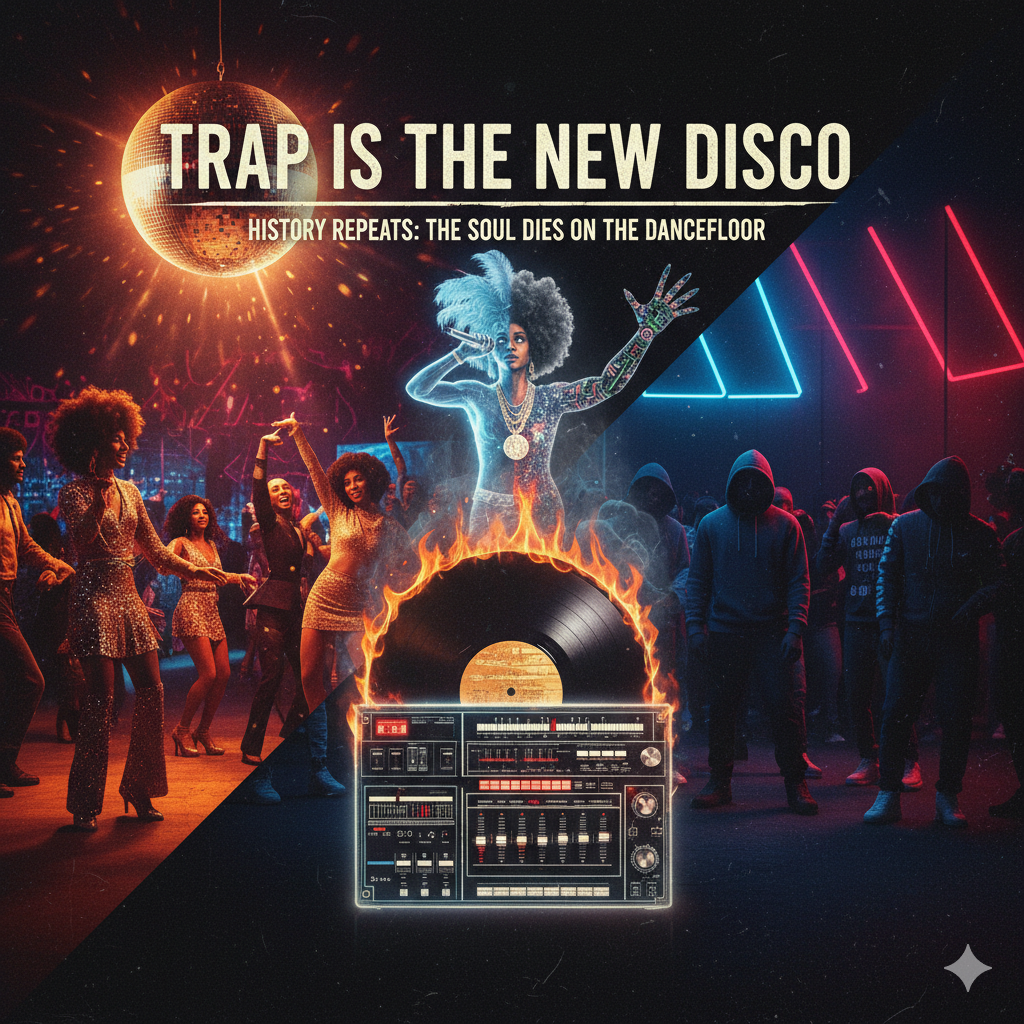
History has a funny way of looping. In the late 1970s, music purists declared that Disco was killing the soul of R&B. In the 2010s, Hip Hop purists declared that Trap was killing the lyricism of Rap. When you peel back the layers, the parallels are undeniable.
The Core Thesis: Trap music to Hip Hop is exactly what Disco was to R&B. It represents a cultural pivot from storytelling and live instrumentation toward mechanical perfection, repetition, and high-energy escapism.
Before the Disco era, the singer or the band leader was the face of the music. In the "Golden Era" of Hip Hop (the 90s), the MC (Rapper) was the undisputed king.
Both Disco and Trap flipped this hierarchy upside down. The architect of the sound became more important than the person holding the microphone.
The biggest criticism leveled at both genres was that they lacked "substance." This argument misses the point of why these genres exist. They aren't designed for a coffee shop listening session; they are designed for physical reaction.
Critics of 70s Disco claimed it was repetitive, plastic, and overly manufactured compared to the grit of Funk or Soul. Similarly, critics of Trap often label it "Mumble Rap," citing repetitive hooks and a lack of complex storytelling compared to Boom Bap.
Both genres prioritized the Vibe over the Content. The goal was to induce a trance state—whether that was on a lighted dancefloor in 1978 or a mosh pit in 2018.
| Feature | Disco Era (70s) | Trap Era (2010s/20s) |
|---|---|---|
| Rhythm Foundation | "Four-on-the-Floor" Kick Drum | The Roland TR-808 Bass |
| Technological Shift | Synthesizers replacing horns | VST Plugins replacing samples |
| The Environment | The Discotheque (Escapism) | The Club/Festival (Escapism) |
| Cultural Impact | Dominated Charts | Dominated Charts |
You cannot separate these genres from the technology that birthed them. Both movements were driven by new hardware that allowed for "superhuman" timing.
I'm not saying this shift is inherently "good" or "bad"—that is for history to decide. But if I'm being honest? For me, it has been terrible.
We are watching exactly what happened to R&B in the late 70s happen to Hip Hop all over again. The soulful, human element is being stripped away in favor of a formula. But frankly, this should be expected.
Record labels only care about profits. If the algorithm rewards a 2-minute repetitive loop, that is what they will fund. If artists keep selling their souls for the quick check rather than the craft, then it is what it is.
Trap music and Disco are two sides of the same coin, separated by 40 years. They were both movements that democratized music making, enraged the purists, and ultimately changed the DNA of pop culture forever—whether we like the result or not.


